Her Calf Felt Like It Was Going to Explode — But the Problem Wasn't in Her Calf
Updated: 4 days ago
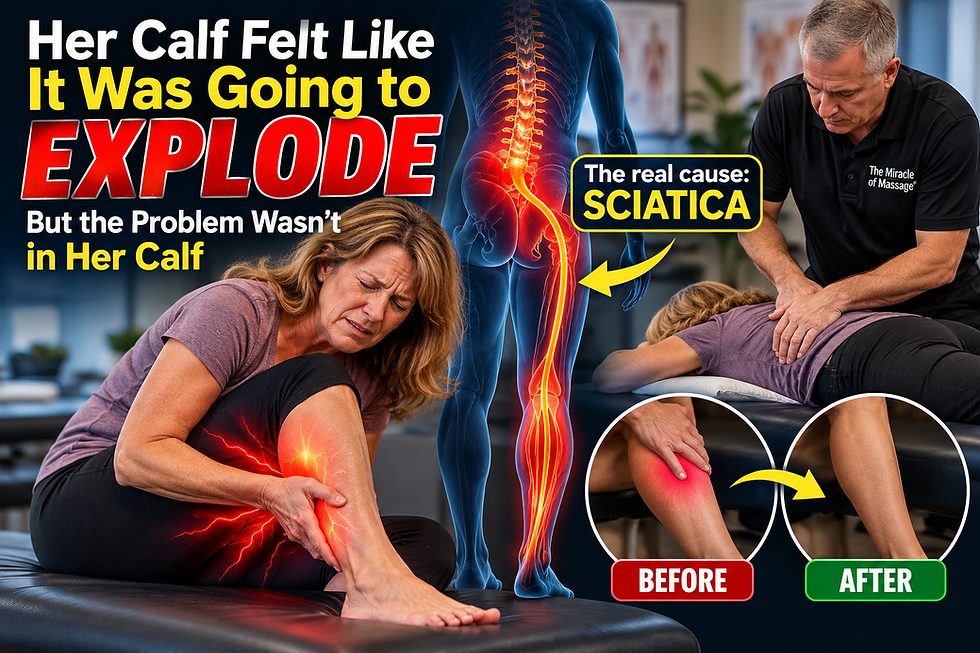
A woman in her mid-50s recently came into The Miracle of Massage in Conyers, Georgia, accompanied by her husband.
She was dealing with something frightening.
Her right calf felt extremely tight, intensely painful, and—as she described it—like it wanted to explode.
And this wasn't something they had ignored.
She had already seen her primary care doctor and had been referred to a pain doctor. X-rays had been taken. She had seen a massage therapist. She had tried acupuncture.
Her husband had even massaged the painful calf that very morning.
Yet the pain and that terrible feeling of pressure and tightness remained.
When she explained everything to me, however, I didn't start by massaging her calf.
I started asking questions.
“Do you have any lower-back pain?”
“Any hip pain?”
“Have you had pain in your buttock—particularly on the right side?”
That last question produced an interesting answer.
She told me that she had experienced pain there previously, although she wasn't feeling it anymore.
That mattered.
So instead of immediately working on the place that hurt, I performed a sciatica assessment.
What I found changed the direction of the entire session.
Sciatica Doesn't Always Look Like “Classic Sciatica”
Many people think they know what sciatica feels like.
Pain starts in the lower back or buttock and shoots all the way down the back of the leg—maybe into the foot.
And yes, sciatica can present that way.
But it doesn't have to.
Symptoms associated with irritation or compression affecting the sciatic nerve or its nerve roots can sometimes be felt predominantly in one portion of the leg.
For one person, the major complaint may be around the knee.
For another, the ankle or foot.
Someone else may describe tingling or unusual sensations in the toes.
And sometimes, as in this woman's case, the calf may be where the person notices the problem most.
That's why simply asking “Where does it hurt?” isn't enough.
I want to know:
Why does it hurt there?
I Treated the Problem I Found — Not the Calf
Based on my assessment, I treated her according to what I had found rather than simply chasing the painful area.
At the end of that first session, she looked at me and asked a perfectly reasonable question:
“When are you going to massage my calf?”
My answer surprised her.
I wasn't.
I explained that I didn't believe her calf itself was the source of the problem.
The calf was where she was feeling the problem.
Those aren't necessarily the same thing.
Then came my favorite part.
I asked her to get off the table and walk around.
After she had taken a few steps, I asked:
“Is your calf still tight?”
She said no.
It felt normal.
And then I pointed something out:
“I haven't touched your calf.”
That moment explained my philosophy better than any advertisement ever could.
Pain Is the Messenger. Find Out Who Sent It.
At The Miracle of Massage, I don't want to spend an entire session chasing the spot that hurts simply because that's where you're pointing.
Sometimes that's exactly where treatment needs to occur.
Sometimes it isn't.
My job is to investigate.
That's why I call myself the Pain Mechanic.
If the warning light comes on in your car, a good mechanic doesn't replace the warning light.
He finds out what made the light come on.
I approach pain the same way.
Your calf hurts.
Your foot burns.
Your toes tingle.
Your hip aches.
Your leg feels tight.
Your first instinct may understandably be:
“That's where the problem is.”
But your body doesn't always work that way.
Sometimes the painful area is giving us a message about something happening somewhere else along the system.
And if all we do is repeatedly work on the symptom without asking what's producing it, we may spend a lot of time chasing pain instead of understanding it.
Could Your Calf Pain Actually Be Related to Sciatica?
If you're experiencing unexplained calf pain, leg tightness, burning, tingling, numbness, buttock pain, hip pain, or pain traveling into the leg, don't automatically assume the place that hurts is the place where the problem begins.
There is also an important exception: new, severe, unexplained calf pain—especially with swelling, warmth, redness, tenderness, chest pain or shortness of breath—needs prompt medical evaluation because a blood clot or another medical problem must be ruled out.
But when serious medical causes have been evaluated and the pain continues, it may be time to ask a different question:
What if we've been treating the symptom instead of looking for the cause?
That's precisely what the Sciatica Pain Mechanic Assessment at The Miracle of Massage is designed to investigate.
At The Miracle of Massage, sciatica care now begins with an assessment—not with purchasing an hour of massage. The purpose of the assessment is to determine whether your symptoms are consistent with a problem we may be able to help with. If you qualify for treatment, we'll explain what we found and recommend an appropriate treatment plan.
YOUR PAIN MAY NOT BE COMING FROM WHERE YOU FEEL IT.
Stop chasing the pain. Let's investigate what's causing it.
→ Book a Sciatica Pain Mechanic Assessment

Comments