When Relaxation Isn’t Enough: A Story About the Massage That Actually Fixed the Problem
Updated: Feb 25
She booked the appointment thinking she just needed to relax.
Long week. Tight shoulders. That familiar ache in her lower back that had been quietly stealing her sleep for months. She didn’t want medical. She didn’t want clinical. She just wanted a calm room, soft music, and a Swedish massage to “loosen things up.”
That’s what she asked for.
And that’s where the story could have ended—with scented oil, gentle strokes, and a polite comment like, “Wow, you’re really tight. You should probably get that checked.”
You’ve heard that before.
Maybe you’ve lived it.
The Difference Most People Don’t Realize Exists
A traditional spa Swedish massage is designed for relaxation, not resolution.
It’s great for stress relief.
It’s wonderful for calming the nervous system.
It feels good—for a while.
But when there’s chronic pain, nerve impingement, hip dysfunction, sciatica, neck and shoulder pain, or referred pain traveling into the arms, legs, knees, or feet, relaxation alone often isn’t enough.
Most spa-based massage therapists are trained to notice a problem—but not to solve it.
They can tell you:
“Your shoulders are really tight”
“Your lower back is inflamed”
“Something feels off here”
And then… the session ends.
Now Let Me Tell You What Happened Next
Halfway through her session, something changed.
Her therapist paused—not in uncertainty, but in recognition.
This wasn’t just tension.
This wasn’t stress.
This was a mechanical issue—muscles pulling out of balance, nerves being compressed, structures compensating for something deeper.
And instead of saying “You should see someone about that,”
he switched gears.
Without breaking the flow of the session, the massage transitioned from relaxation to precision pain relief.
Different pressure.
Different angles.
Different intent.
Glutes addressed because leg pain starts in the hips.
Deep stabilizers engaged because the spine doesn’t fail alone.
Nerve pathways followed—not guessed at.
Still calm.
Still professional.
But now purposeful.
This Is Where a Pain-Relief Massage Specialist Changes Everything
A massage therapist trained in medical massage, pain relief massage, and mechanical body correction doesn’t have to choose between:
spa massage or
therapeutic work
They can do both—in the same session.
That’s the advantage.
Instead of booking multiple appointments with different providers… Instead of being told “massage can’t fix that”… Instead of bouncing between relaxation and frustration…
Your session becomes customized in real time.
The therapist adapts:
If it’s stress → calm it
If it’s mechanical → correct it
If it’s nerve-related → decompress it
If it’s chronic → address the cause, not the symptom
All within the time you already booked.
Why This Matters for Real People With Real Pain
Pain doesn’t live in neat categories.
Your “tight neck” might be coming from your upper back.
Your knee pain may start in your buttocks.
Your arm numbness could originate in the shoulder girdle.
Your lower back pain may be a hip stability problem in disguise.
A spa-only approach can’t pivot when the body tells a different story.
A pain-relief specialist expects that story to change.
That’s Exactly What We Do at The Miracle of Massage
At The Miracle of Massage, relaxation is never wasted—but it’s never the end goal.
We specialize in:
Pain relief massage in Conyers GA
Medical massage for chronic pain
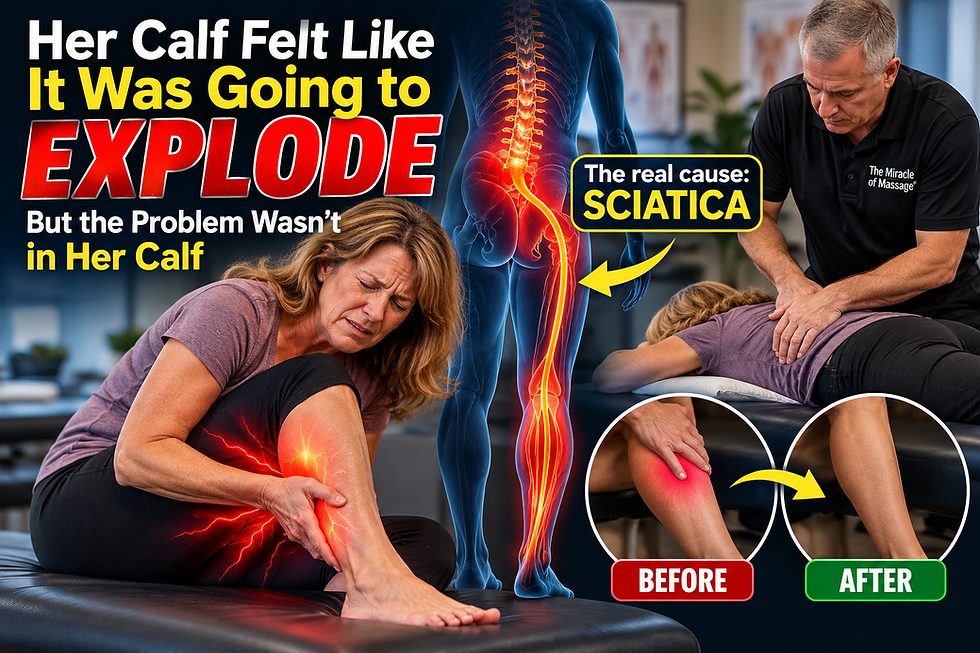
Sciatica and nerve impingement relief
Neck and shoulder pain treatment
Hip, glute, and lower back correction
Customized massage therapy sessions
Every session is adaptable.
Every body is assessed, not assumed.
Every minute is used to your best advantage.
If you want a massage that only tells you something is wrong, a spa can do that.
If you want a massage that can switch gears, identify the real issue, and work toward fixing it—
that’s where we come in.
Final Thought
Relaxation feels good.
Resolution changes lives.
And when your massage therapist has the skill to do both,
you don’t just leave feeling better—
You leave moving better, sleeping better, and finally understanding what your body has been trying to say all along.


Comments