Three Surgeries Later, His Arm Still Hurt — Then I Asked About His Chest
He came to see me for his lower back pain.
But when I walked into the waiting area, something else immediately caught my attention.
The gentleman, in his mid-50s, was sitting there with his right arm in a sling.
He hadn't made the appointment about his arm. He hadn't even complained to me about it.
But I was curious.
“What happened to your arm?”
What followed was the story of an extraordinarily painful journey.
He told me that he had been experiencing excruciating pain in his right hand and arm. He had been diagnosed with carpal tunnel syndrome and told that surgery could correct the problem.
He underwent surgery.
But the pain remained.
Then another procedure.
And another.
Three surgeries later, he told me that he was still in excruciating pain — and now he could no longer properly use his hand.
I couldn't change what had already happened.
But I wanted to understand why he was still hurting.
So I asked his permission to examine an area that might seem completely unrelated to his hand.
His upper chest.
He agreed.
Before I did anything, I asked him to rate the pain he was experiencing at that moment.
10 out of 10.
During my assessment, I found an area in his right upper chest that appeared to be significantly involved in his symptoms.
I placed two fingers over the area with moderate pressure and held it for approximately two minutes.
Then I removed my fingers.
“What's your pain level now?”
His answer stunned even him.
“Two.”
From 10/10 to 2/10.
And I had never touched his hand.
The Pain Was in His Hand. The Problem Wasn't.
Based on my assessment and his response to treatment, the muscular involvement around his upper chest appeared to be affecting the nerves associated with his arm and hand symptoms.
That distinction matters.
The place where you feel pain is not necessarily the place where the problem originates.
Over the course of his treatment plan, we were able to resolve the arm and hand pain he had presented with.
Unfortunately, the loss of hand function that he reported following his surgical journey was something I could not reverse.
And that is the part of his story that has stayed with me.
Why We Assess Before We Treat
This is exactly why The Miracle of Massage no longer begins by simply selling someone an hour of massage.
If you come to me with hand pain, I don't automatically massage your hand.
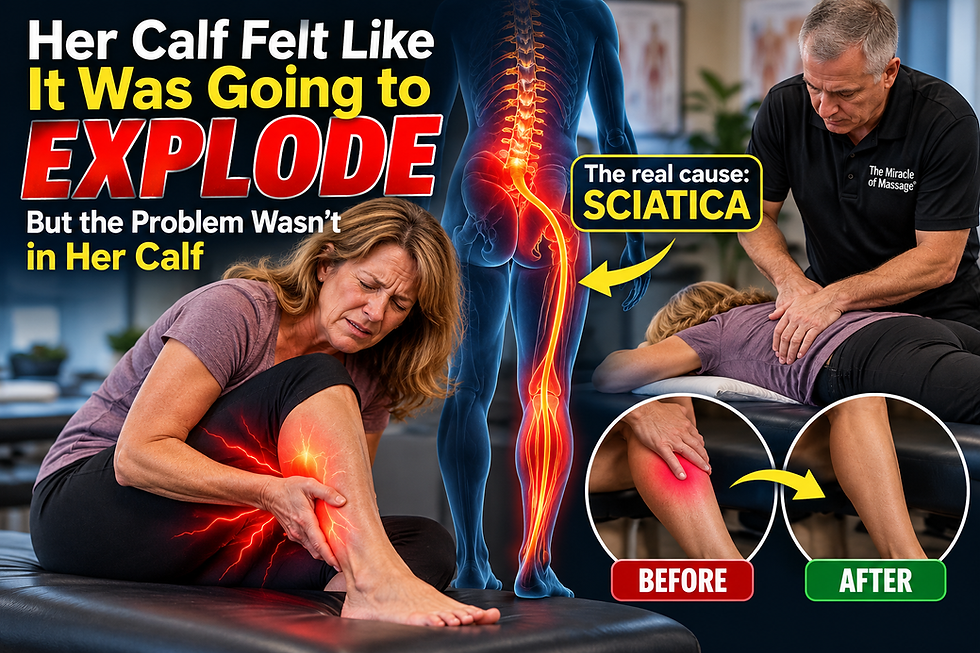
If you come with calf pain, I don't automatically massage your calf.
If you come with sciatica, I don't automatically put you on the table and start working.
First, we assess.
We look for patterns. We test. We ask questions. We try to determine whether what you're experiencing is something my work may be able to help.
If you qualify for treatment, then we develop a treatment plan based on what the assessment tells us.
Because around here, the goal isn't simply to spend an hour working where it hurts.
The goal is to find what is causing it.
And sometimes...
the most important place to investigate is the place nobody has been looking.
Individual experiences vary. This story describes one client's experience and is not a guarantee of results. Massage/bodywork does not replace medical diagnosis or treatment. New or severe arm/hand pain, weakness, numbness, or loss of function should be medically evaluated.


Comments